🕳️ Webb finds two giant black holes that 'shouldn't exist' so early
Astronomers using the James Webb Space Telescope have spotted the earliest known pair of quasars, seen as they were when the cosmos was only about 900 million years old.
The mystery
Today's theories say supermassive black holes need over a billion years to grow huge. Yet Webb has caught two of them, already enormous and sitting close together, when the universe was a small fraction of its current age.
The answer
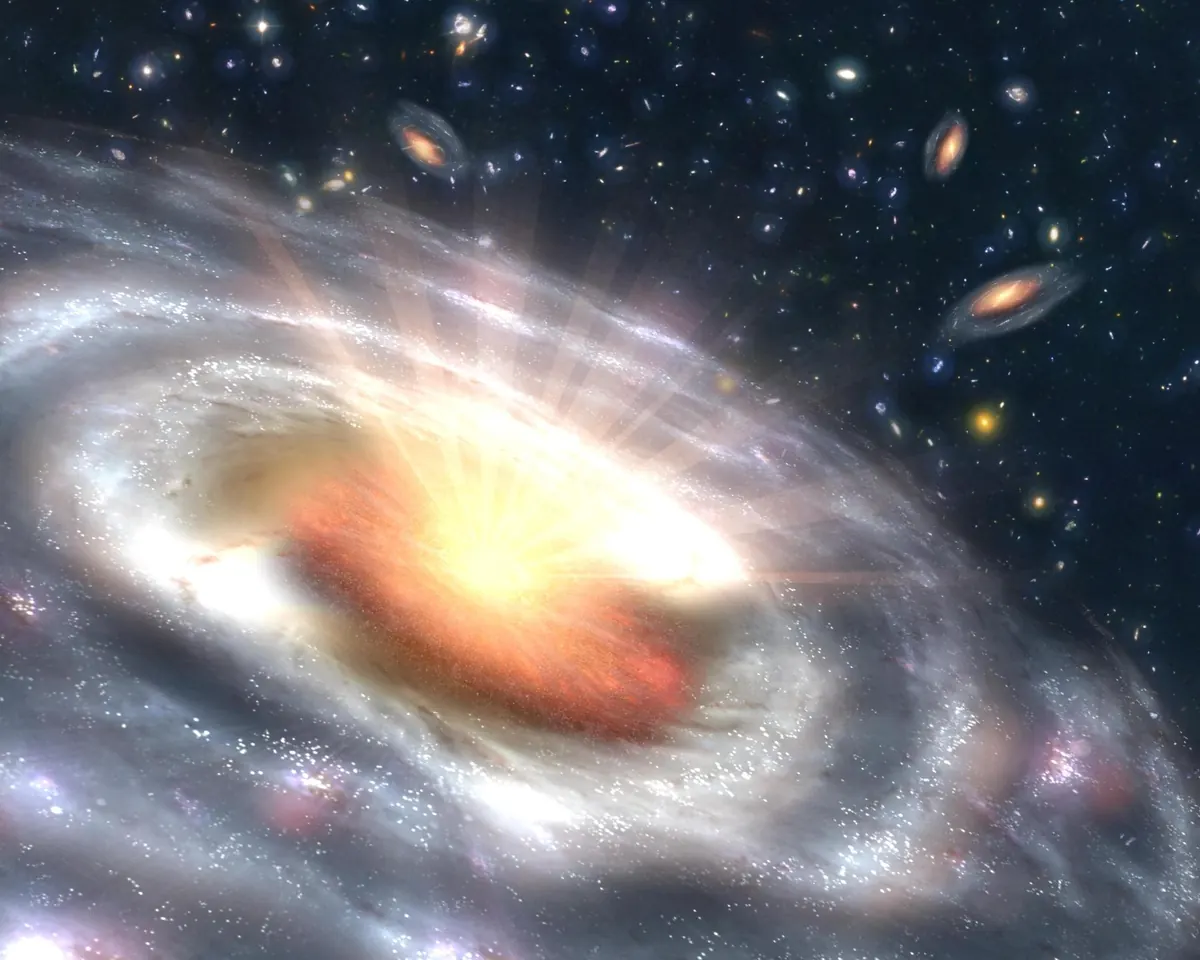
The pair, catalogued as J1602+4228AB, was found with Webb and the Gemini North telescope. It has been given a long Hawaiian name, Nāpōwawāʻenakaulua, describing two powerful dark bodies. One holds roughly 1.5 billion solar masses and its partner around 400 million; they sit only 18,100 light-years apart — roughly a fifth of the Milky Way's width. That makes this the tightest quasar pair known from Cosmic Dawn, the era when the first stars and galaxies formed. A quasar is a feeding black hole whose surrounding disk of gas gets so hot it can outshine its whole galaxy. Team leader Silvia Onorato of NOIRLab said no theory fully explains even one such quasar existing this early, let alone two, and noted their masses already match those of black holes seen today.
Now think about this
If giant black holes formed far faster than expected, what might that tell us about how the first galaxies were born?