🔭 Hubble maps cosmic 'lenses' ahead of NASA's Roman telescope
A new Hubble gallery of gravitational lenses gives the upcoming Roman Space Telescope a list of targets and could help test ideas about dark matter.
The mystery
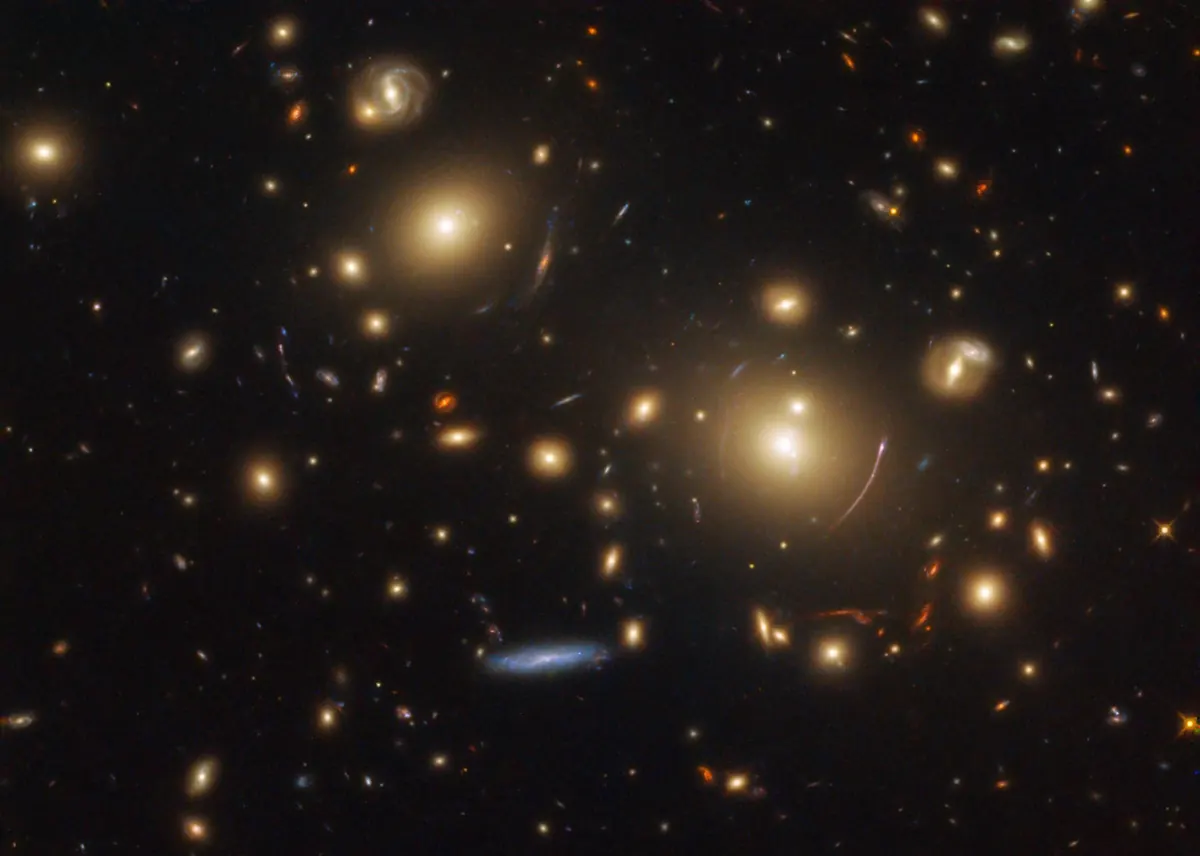
Some galaxies act like giant magnifying glasses, stretching the light of galaxies far behind them into glowing arcs. These natural lenses let astronomers peer deeper than any telescope could alone. They may also reveal where invisible dark matter hides.
The answer
NASA has released a set of Hubble images showing many different gravitational lenses. Each one forms when a nearby galaxy sits almost exactly in front of a more distant one. The closer galaxy's gravity bends and enlarges the background light, so the far galaxy shows up as curved arcs around it, an effect Albert Einstein predicted. By measuring how strongly those arcs are warped, researchers can work out how much mass the foreground galaxy holds, including dark matter that gives off no light. The team plans to build lens models that might support or rule out one dark matter theory. Hubble sees mostly visible and ultraviolet light in sharp detail, while the Nancy Grace Roman Space Telescope works mainly in infrared across a far wider field. Roman should therefore find many more lenses, and Hubble can zoom in on the most interesting ones.
Now think about this
If most of a galaxy's mass is invisible, how sure can we be about what the universe is really made of?